
Cabling Contractor Selection Questions Every Business Should Ask Before Starting a Network Infrastructure Project

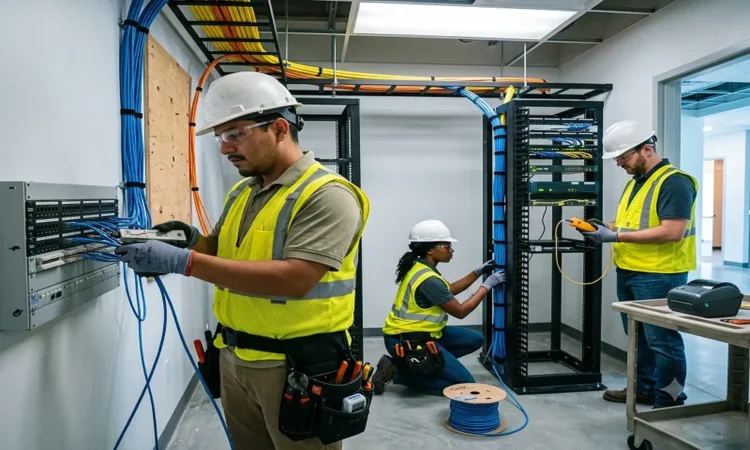
Key Points:
- A clear project scope helps prevent cost and scheduling surprises later.
- Site walkthroughs can reveal pathway and access issues drawings may miss.
- Cable choices should match speed, distance, power, and future network needs.
- Testing standards should be confirmed before installation work begins.
- Strong coordination helps cabling projects fit around active business operations.
- Clear documentation makes future repairs, moves, and upgrades much easier.
- Proper labeling helps technicians trace connections without disturbing working systems.
- Practical spare capacity can reduce disruption during future network expansion.
- The right contractor should balance current requirements with realistic long-term growth.
Choosing the right company for a network cabling project is rarely as simple as comparing prices. Commercial sites may need new data drops, fiber backbones, Wi-Fi support, cameras, phones, or connections between several telecom rooms. The work has to fit around existing systems and daily operations. A low quote can look attractive at first, but unclear planning often shows up later as delays, rework, messy racks, or links that are difficult to troubleshoot.
The useful questions start before anyone pulls cable. Businesses should understand how the provider surveys the site, chooses materials, handles testing, coordinates access, and documents the finished network. They should also ask what happens when the plan changes halfway through, because commercial projects do that. A ceiling closes early. A department moves. Another trade blocks a route. The better providers are prepared for those moments instead of treating every surprise as a new problem.
Cabling Project Scope Before Work Begins
A reliable cabling contractor should be able to explain the project scope in plain language before installation starts. That includes which areas are being served, what cable types are proposed, where pathways will run, and what equipment rooms are involved. A proper walkthrough matters here. Drawings help, but they may not show crowded ceilings, blocked risers, restricted rooms, or existing cable that changes the route once crews reach the site.
Businesses should also ask how changes to scope will be handled. Maybe ten additional drops are added after furniture plans change, or a conference room suddenly needs another access point. Those changes are normal, but they should not create confusion over cost or timing. A clear process for approvals, revised quantities, and schedule updates keeps the project under control. It also gives business owners a realistic view of what is included and what would count as extra work.
Testing Standards Need Clear Answers
Testing is one of the easiest places for proposals to sound similar while meaning very different things. A business should ask exactly what will be tested, what standard will be used, and whether final results will be provided. A link that lights up is not necessarily a link that performs properly. Weak terminations, damaged cable, or installation errors can stay hidden until heavier traffic exposes them weeks after the crew has left.
Larger projects make formal testing even more valuable. If 180 links are installed across several floors, one bad termination can disappear in the crowd until a user reports an odd problem later. A careful team should identify failed links, correct them, and retest before handover. That takes a little more time at closeout, but it creates a much cleaner starting point for the IT team and reduces the amount of detective work required after the network goes live.
Cable Services Should Match Network Requirements
Professional cabling services should be based on what the network actually needs, not on one standard recommendation used everywhere. Desk connections, wireless access points, cameras, backbone links, and long-distance runs can have very different requirements. Speed, distance, Power over Ethernet, equipment compatibility, and future demand all influence the choice. Businesses should expect the provider to explain why copper, fiber, or a combination makes sense for each part of the project.
The supporting hardware deserves the same discussion. Patch panels, racks, connectors, switches, and pathways all affect how useful the finished installation will be. Premium cable inside a cramped, poorly organized telecom room is not much of a win. A good proposal should show how the pieces fit together, where capacity exists, and where limits may appear. That level of detail makes it easier to compare options without reducing the decision to cable category and price per drop.
Project Coordination Matters in Active Workplaces
A second Cabling Contractor question should focus on how the team works around active business operations. Commercial sites may have meetings, secure rooms, customer areas, or departments that cannot lose connectivity during the day. The provider should explain how work will be phased, when noisy tasks will happen, and how live connections will be protected. Good scheduling is not glamorous, but it can decide whether the project feels controlled or constantly disruptive.
Coordination with other trades matters just as much. Electricians, security installers, ceiling crews, and mechanical teams may all need the same routes or access windows. Problems start when everyone assumes a pathway will still be available later. Businesses should ask who manages those overlaps and how schedule changes are communicated. A ten-minute update can prevent a lost morning, while silence can turn a small access problem into a delay that affects several crews at once.
Documentation Should Support Future Network Work
Strong Cabling Services should end with more than a functioning network. Businesses should know what documentation they will receive, including labels, test reports, port maps, rack information, and updated drawings where appropriate. Those records become surprisingly valuable later. If a department moves or a switch is replaced, technicians can trace the system quickly instead of opening cabinets and guessing which unlabeled cable goes where during a busy service call.
The quality of the handover says a lot about the quality of the project. Clear labels on wall outlets, patch panels, and cable runs make future service far less painful. So does a tidy rack. It may seem like a finishing detail, but it is not. Six months later, when someone needs to add twelve workstations over a weekend, good records can turn that change into a planned task instead of several hours of tracing old connections.
Growth Planning Should Be Practical, Not Excessive
Network infrastructure should leave some room to grow, although that does not mean every project needs maximum spare capacity. Businesses should talk openly about planned hiring, new cameras, additional access points, future floors, or expected equipment changes. Those details help the provider decide where spare ports, pathway room, or stronger backbone links are worthwhile. The goal is to prepare for likely growth without spending heavily on capacity that may never be used.
There is a tradeoff. Building a little flexibility into the first project may raise the initial cost, but reopening ceilings or rebuilding telecom rooms later can cost much more. Consider an office that expects 50 extra employees within eighteen months. Leaving suitable pathway space now may be sensible. Adding unused infrastructure everywhere probably is not. A good provider should help the business separate realistic future needs from expensive just-in-case additions that offer little practical value.
Conclusion
The right cabling provider should make the project easier to understand before making it easier to install. Businesses should ask about scope, material choices, testing, coordination, documentation, and future growth before signing off on the work. Those questions reveal whether the provider is thinking only about the immediate cable pull or about the network as working infrastructure. That difference matters later, when the business expands, equipment changes, or a problem needs to be traced quickly.
CMC Communications supports commercial properties with structured cabling, network cabling, fiber installation, testing, and related infrastructure services. Their team can review building conditions, equipment needs, cable routes, operating schedules, and likely growth before work begins. That broader planning can help businesses avoid short-term choices that create expensive rework later, while giving them a cleaner network foundation that is easier to document, troubleshoot, maintain, and expand as technology needs continue to change.
Frequently Asked Questions
Question: What should a business ask before accepting a cabling quote?
Answer: Ask what is included in the scope, which materials are proposed, how testing will be handled, what documentation will be provided, and how changes are priced. A clear quote should make it easy to understand what the business is actually buying and which items could create extra costs later.
Question: Why is a site walkthrough important before installation starts?
Answer: Drawings may not show crowded ceilings, blocked pathways, restricted areas, or existing cable conditions. A walkthrough helps the team see those issues early and choose routes that are practical before labor and materials are fully committed to the project.
Question: Should every installed cable be tested?
Answer: The testing approach depends on the project, but businesses should know what will be verified and what results they will receive. Proper testing can identify weak links, damaged runs, or installation faults before employees begin depending on the finished network.
Question: How much spare capacity should a business plan for?
Answer: Enough to support realistic growth. Expected staff increases, new devices, additional access points, or planned expansions should guide the decision. The aim is useful flexibility, not paying for large amounts of infrastructure with no clear future purpose.
Question: Why do labels and closeout records matter after installation?
Answer: Good records help technicians trace ports, cables, racks, and test results quickly. They reduce guesswork during repairs, office moves, and upgrades, which can shorten service time and lower the risk of accidentally disturbing connections that are already working properly.
| CONTENT CHECKLIST | |
| Total Word Count | 1595 |
| Grammarly Premium Score | 96 |
| Readability Score | 48 |
| Plagiarism | 100% |
| Primary Keyword Usage | 2 times |
| Secondary Keywords Usage | 2 Times |
| Highest Word Density | 1.5 |
| Brand Name Integration | 1 Time |
| Ai Detection Score | 7 |
| Maximum Paragraph Length | 6 Lines |
| FAQs | 5 |